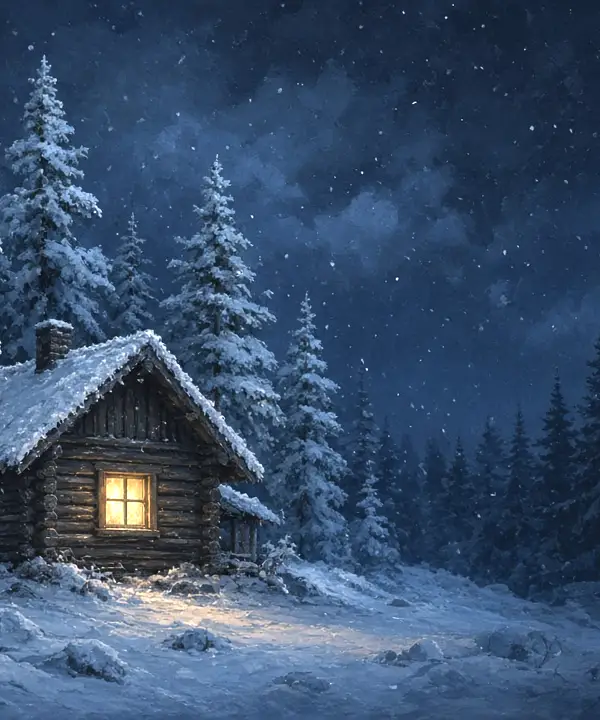
People who grew up along the pine roads east of the Sabine will tell you the woods are fine in daylight. The trees stand in orderly rows where the timber companies planted them, and the ditches run straight enough that you can drive a farm-to-market road with one hand on the wheel and a sweet tea in the other.
It is after dark that the same stretch of road starts to feel longer than the map says it should.
This is a story they tell about a night like that — not a newspaper clipping, not a sworn report. Just a tale that has been passed from porch to porch, the way a good scare should be.
There was a young man, they say, who borrowed his uncle’s lantern and walked out to check a fence line after a storm. The power was out. The gravel drive was a pale ribbon, and the pines on either side of it made a wall you could not see through. He was not far from the house — he could still smell the wet ash from the chimney — when the lantern fluttered, recovered, and then died as cleanly as if someone had pinched the flame.
He stopped. He shook the lantern. There was oil enough. He struck a match, lit it again, and took three more steps. The flame shrank to a blue bead and went out.
The third time, he did not bother walking. He stood in the dark and listened.
At first there was only the drip of rain from the needles, and the far-off complaint of a truck on the highway. Then, from the ditch to his left, something large shifted its weight. Not a deer. Deer do not wait that patiently, and they do not smell like wet leaves piled too long in a shed. The young man felt the hair on his arms lift, the way it does when lightning is close.
He spoke, because people in stories always speak, even when they should not. “Who’s there?”
Nothing answered. The thing in the ditch did not run. It did not come closer, either. It simply occupied the dark, as if the dark were a room it had been sitting in all evening, and he was the one who had opened the door.
He lit the lantern a fourth time. The flame held — barely — and in that thin gold circle he saw the weeds along the ditch lean, then spring back, as though a shoulder had brushed them. Above the weeds, just for a breath, two points of light looked back at him. They were too high for a raccoon and too steady for the reflection of his own flame on standing water.
Then they were gone, and the lantern died again, and he was alone with the sound of his own breathing.
He did not check the fence that night. He walked backward toward the house until his heel found the porch step, and he did not turn around until the kitchen door was shut and bolted.
In the morning the fence was fine. The ditch held only rainwater and a crushed path in the broom weed, wide as a man’s shoulders and longer than it needed to be. His uncle looked at the path, looked at the lantern, and said the only useful thing anyone in that family ever said about the woods:
“If the light won’t stay lit, you come home. Whatever wanted the dark can keep it.”
They still tell it when the power flickers and someone reaches for a flashlight. They say the young man grew up and stayed in town and never much cared for camping. They say that on certain wet nights, drivers on that farm-to-market road notice their headlights dip for no reason — a brief dimming, like a courtesy — and they ease off the gas until the beams come back strong.
It may be only a story. The pines are full of those.
But if you ever walk that road with a lantern, and the flame goes out once, you might laugh and light it again. If it goes out twice, you might blame the wind. If it goes out a third time, you would do well to remember the uncle’s advice.
Come home. Leave the dark to whatever has been waiting in it.